
End-to-end (E2E) automation is under permanent changes, and developers and testers strive to find more efficient, reliable, and scalable options. Selenium-like frameworks were always preferred over the last several years, with the advent of Playwright, the new paradigm was established, especially with the groundbreaking idea of Test Agents. These agents are not the new feature; they have radically altered the way we do E2E testing with a promise of faster feedback, more reliable tests, and eventually better quality software.
A Playwright Test Agent is, at its simplest, a smart, self-contained around, and controls the E2E tests in a highly optimized and isolated setting. It can be thought of as a custom-made robot, whichis specially designed to navigate and interact with your web application, but with unmatched precision and speed. Playwright Test Agents simplify the process, unlike the traditional E2E setups that may be based on massive browser installations and convoluted orchestration.
The issue of conventional E2E Automation.
It is important to know the issues that Test Agents deal with before plunging into the positive side of them. Conventional E2E automation usually struggles with:
• Flakiness: Tests may fail randomly because of timing, race conditions, or other environmental variations. It results in the wastage of time in debugging and mistrust in the test suite.
• Slowness Because browsers, complicated UIs, and many actions may take time (so much time) to run, large test suites may be incredibly slow. This does not support quick feedback and agile development.
• Complexity: The creation and management of an effective E2E testing environment can be quite an intimidating endeavor and needs experience in browser drivers, environment setups, and parallel run-off policies.
• Resource Intensiveness: The process of executing multiple instances of a browser is resource-intensive, that is, it requires a lot of CPU and memory, and therefore, parallelization is very expensive and is usually not very high.
Such obstacles often lead to developers not doing E2E tests and instead running faster, but less comprehensive, unit and integration tests. As important as they are, they still do not cover the entire user experience, and they will leave loopholes in tests that may introduce critical bugs in production.
Playwright Test Agents: A New Approach.
Playwright Test Agents address these issues directly by changing the paradigm of the way the tests are performed. This is the way they are transforming the game:
• Headless-First and Native Browser Interactions: Playwright is very good at running headless browsers, i.e., tests that run in the background and do not have an interface. This is much more efficient and quicker. More to the point, the direct communication of Playwright with browser API,s as opposed to using an intermediary WebDriver, creates more stable and reliable tests. This is exploited by Test Agents,s which offer a simplified platform on which these native interactions can occur.
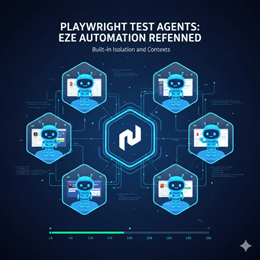
• Intrinsic Isolation and Contexts: Each Playwright Test Agent is in its own context. This implies that the execution of tests in different agents can not interfere with each other, so it does not have a common cause of flakiness. Think of having hundreds of tests that would run simultaneously, each in its own clean environment, and not affected by the side effects of the other tests.
- Auto-Waiting and Robustness: Intelligent auto-waiting is one of the most comprehensive features of Playwright, which is implicitly used by Test Agents. Playwright will automatically wait to see, enable, and stabilize elements before interacting with them, rather than making (usually brittle) calls to setTimeout to delay interactions. This drastically decreases test flakiness due to timing variation, and strengthens tests and makes them dependable.
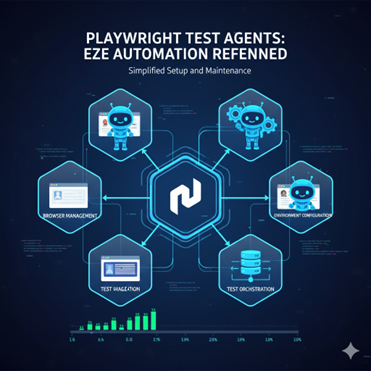
- Minimized Installation and maintenance: The design of Playwright focuses more on ease of use. Test Agents represent this by hiding much of the underlying complexity of managing browsers and managing test orchestration. This implies that less time is wasted on setting up environments and more meaningful tests are written.
Conclusion
The use of Playwright Test Agents (Planner, Generator, and Healer) signals the move towards agentic testing as opposed to automated testing. We are no longer living in a world where 70 percent of the time of QA engineers is devoted to struggling with flaky selectors and flaky scripts.
Through these agents, teams will be able to reach:
- Lightning Fast: Create dozens of test cases based on simple Markdown plans in minutes.
- Resilient Suites: Have the “Healer” agent repair failed tests in the background, so that CI/CD pipelines remain green.
- Learn Strategy: Human testers are released to work on the higher-level test strategy, edge cases, and exploratory tests that AI is still unable to accomplish.
Playwright Test Agents are not merely a luxury as we look to the future of 2026 and beyond, but they are quickly becoming a necessity to those teams that wish to stay on a high velocity but not compromise the quality of the software. As well, in case you have not been playing around with the agentic loop, now is the moment. With QACraft, embrace the future of E2E automation and stay ahead with intelligent, scalable testing solutions.
Comparison: Traditional vs. Agent-Based E2E
| Feature | Traditional Automation | Playwright Test Agents |
| Creation | Manual scripting (Hours) | AI-Generated from plans (Minutes) |
| Maintenance | Manual locator updates | Self-healing via the Healer agent |
| Logic | Rigid, hard-coded | Adaptive and context-aware |
| Scaling | Slow and resource-heavy | Rapid with native isolation |

