
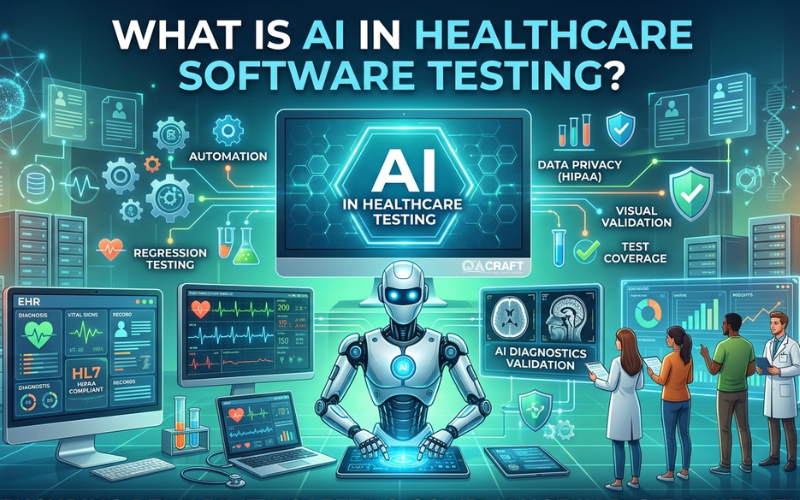
Healthcare technology is evolving rapidly with digital health platforms, telemedicine apps, electronic health records (EHR), and AI-driven diagnostics. As healthcare software becomes more complex, ensuring quality, security, and regulatory compliance becomes critical.
AI in healthcare software testing helps organizations automate testing, detect defects faster, and ensure compliance with strict healthcare regulations.
Understanding AI in Healthcare Software Testing
AI in healthcare software testing refers to the use of machine learning, data analytics, and intelligent automation to improve software testing processes for healthcare applications.
Healthcare software must handle:
- Sensitive patient data
- Complex integrations between systems
- Regulatory compliance requirements
- High system reliability
Traditional testing methods often struggle to keep up with these challenges. AI helps QA teams by:
- Automatically generating test cases
- Detecting defects using pattern analysis
- Predicting high-risk modules
- Automating repetitive testing tasks
This leads to faster testing cycles and more reliable healthcare applications.
To understand how healthcare apps are validated step-by-step, you can read How to Test Healthcare Applications.
Understanding AI in Healthcare Software Testing:
AI in healthcare software testing refers to the use of machine learning, data analytics, and intelligent automation to improve software testing processes for healthcare applications.
Healthcare software must handle:
- Sensitive patient data
- Complex integrations between systems
- Regulatory compliance requirements
- High system reliability
Traditional testing methods often struggle to keep up with these challenges. AI helps QA teams by:
- Automatically generating test cases
- Detecting defects using pattern analysis
- Predicting high-risk modules
- Automating repetitive testing tasks
Challenges of AI in Healthcare Testing
Despite its advantages, AI adoption also comes with challenges.
-Data Privacy Concerns: Healthcare data must comply with strict privacy regulations.
-High Initial Investment: AI testing tools and infrastructure can require significant setup costs.
-Skill Requirements: QA teams need expertise in both AI technologies and healthcare domain testing. For deeper insight into healthcare QA challenges, you can explore Why the Healthcare Industry Needs QA Testing
Conclusion:
AI in healthcare software testing is revolutionizing how healthcare applications are validated. By automating testing processes, predicting defects, and ensuring compliance with strict regulations, AI helps deliver safe, secure, and reliable healthcare software.

