
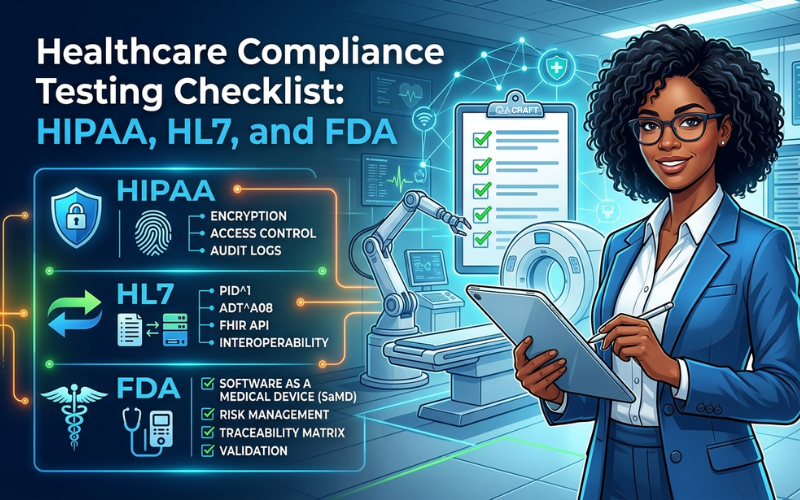
Healthcare software must adhere to comprehensive regulatory standards to safeguard patient data, facilitate seamless integration, and verify medical device safety. Compliance testing plays a vital role in adhering to applications with frameworks like HIPAA, HL7/FHIR, and FDA standards. This checklist scenario structured process helps teams systematically verify security, functionality, and compliance readiness.
Understanding Healthcare Compliance Requirements
▶ HIPAA – Protecting Patient Data
The Health Insurance Portability and Accountability Act (HIPAA) formalizes national standards for protecting Protected Health Information (PHI) and Personally Identifiable Information (PII). It enforces managerial, physical, and technical adherence controls to ensure patient discretion and information security.
▶ HL7/FHIR – Interoperability and Secure Data Exchange
Health Level Seven International (HL7) establishes a global guideline for exchanging healthcare data. Fast Healthcare Interoperability Resources (FHIR) is a contemporary HL7 standard facilitating protected, API-based data exchange between EHRs, telehealth platforms, labs, and insurers.
▶ FDA – Software Validation for Medical Devices
The U.S. Food and Drug Administration regulates software used in medical devices and specific medical applications. Observance Demands Comprehensive testing, risk assessment, Reports, and requirement monitoring.
Consequences of Non-Compliance
Failure to adhere can result in:
- Notable financial penalties and legal obligations
- Patient-related medical Health risks
Loss of Trustworthiness and stakeholder trust
Importance of Compliance Testing in Healthcare
Compliance testing is not just a legal requirement—it is a patient Security Necessary.
- Safeguards patient data, information security, and confidentiality through validated controls
- It will assure validation of system functionality, secure data transmission, and seamless interoperability across different healthcare networks.s
- It also prevents costly financial penalties and compliance breaches by detecting vulnerabilities at an early stage.
improves trustworthiness and credibility with providers, partners, and patients.
By integrating compliance testing into QA processes, organizations minimize risk while enhancing healthcare delivery quality.
Healthcare Compliance Testing Checklist
➥ HIPAA Compliance Testing
An arranged to-do list assures full HIPAA alignment:
- It verifies role-based Permission controls and strong user Authentication
- Assures Encryption at rest and during data transmission
- Verify examination logging and activity tracking mechanisms
- Test backup copies and System recovery protocols
- replicate data breach scenarios and incident response workflows
Testing must verify not only that Regulations exist, but that they function in real-world conditions, in extreme conditions.
➥ HL7/FHIR Compliance Testing
Seamless integration requires Precise validation:
- Validate API and message format guidelines with HL7/FHIR standards
- Test compatibility between EHR systems and third-party applications
- Ensure correct data mapping and Processing
- Verify secure data transmission across networks
- Validate error handling, exception Management, and logging
Consistent HL7/FHIR testing mitigates data Inconsistencies that could affect medical decisions.
➥ FDA Compliance Testing
Clinical device and Governed software validation requires Exhaustive documentation:
- It validates software requirements and technical specifications.
- Perform different functional and performance testing.
- Maintain requirement mapping between requirements, test cases, and results
- Execute risk analysis and mitigation verification
- Validate updates, Hotfixes, and the maintenance process
FDA compliance emphasizes documentation, repeatability, and risk control at every phase of testing.
Tools for Compliance Testing
Efficient compliance testing utilizes domain-specific tools:
- Selenium, Appium – Functional and regression testing
- Postman, SoapUI – API testing for HL7/FHIR validation
- Burp Suite, OWASP ZAP – Security and vulnerability testing
- TestRail, Zephyr – Traceability and audit documentation
- FHIR/HL7 simulators – seamless integration, validation, and message emulation
Tool selection should conform to regulatory coverage, risk level, and structural complexity
Best Practices for Healthcare Compliance Testing
Integrate testing early (Shift-Left Testing). Identify compliance risks during requirements and design phases.
Automate repetitive compliance checks. Automated regression suites help maintain consistent adherence across different releases.
Preserve Comprehensive documentation. Inspectors Demand Precise Monitoring and Verification Evidence.
Conduct periodic compliance audits. Update test strategies based on evolving regulatory requirements.
Prioritize high-risk workflows. It Primarily Emphasize on patient-Mission-critical applications and Confidential data flow.
Integrated regulatory compliance into the SDLC guarantees continuous Standards alignment.
Real-World Use Cases
Ⅰ HIPAA Conformity for a Hospital EHR System
An executed automated security test verifies encryption and permission controls.
Result: 40% minimization in security flaws before independent audits and Enhanced Occurrence Intervention Alertness.
Ⅱ HL7/FHIR API Testing for Telehealth Platforms
A Telemedicine Supplier Utilized API automation and FHIR Simulation to authenticate compatibility with Numerous EHR Partners.
Result: Minimized integration Defects by 35% and Quicker Integration of Associated clinics.
Ⅲ FDA Software Validation for Medical Devices
A medical device Organization Created Start-to-finish Monitoring among specifications and test scenarios.
Lesson learned: Proactive compliance testing reduces long-term costs while improving quality and patient safety.
Conclusion
A structured compliance testing checklist for HIPAA, HL7/FHIR, and Food and Drug Administration regulations enables healthcare organizations to protect patients, ensure interoperability, and validate medical software safety.
By integrating proactive, continuous compliance testing into QA processes, healthcare teams not only avoid regulatory penalties—but also build secure, reliable systems that patients and providers can trust.

