
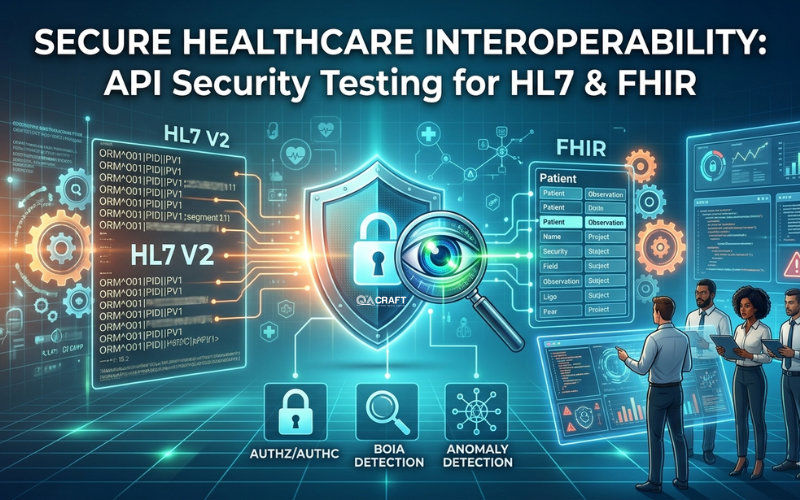
API security testing in healthcare ensures that application programming interfaces (APIs) used for exchanging medical data are protected from vulnerabilities and cyber threats. It helps safeguard sensitive patient information while maintaining compliance with regulations. Standards like HL7 and FHIR enable secure interoperability between healthcare systems, making API security testing essential.

Understanding API Security in Healthcare Systems
APIs allow healthcare applications to communicate and exchange medical data between systems such as electronic health records (EHRs), telemedicine platforms, and hospital management systems.
Role of HL7 and FHIR in healthcare data exchange
- HL7 (Health Level Seven): Standard for exchanging healthcare information between clinical systems.
- FHIR (Fast Healthcare Interoperability Resources): Modern API-based standard that simplifies data sharing using web technologies.
Why healthcare APIs must be secured
- Protect sensitive medical records
- Prevent unauthorized access to patient data
- Ensure safe communication between healthcare platforms
Common API vulnerabilities in healthcare
- Data leaks due to weak authentication
- Unauthorized access to patient records
- Insecure endpoints exposing sensitive information
Why API Security Testing Is Critical for Healthcare?
Healthcare systems handle extremely sensitive information such as PHI (Protected Health Information) and PII (Personally Identifiable Information). API security testing ensures these data assets remain protected.
Key reasons API security testing is essential:
- Protecting patient data: Prevent exposure of medical records and personal information.
- Regulatory compliance: Supports compliance with standards such as HIPAA, HITECH, and GDPR.
- Preventing breaches: Protects EHR systems, telemedicine platforms, and healthcare mobile apps from cyberattacks.
- Reducing operational risk: Security vulnerabilities in APIs can disrupt healthcare services and compromise patient safety.
Types of API Security Testing for Healthcare Systems
Healthcare API security testing includes several techniques designed to identify vulnerabilities before attackers exploit them.
▶ Authentication and Authorization Testing
- Verifies that only authorized users can access healthcare APIs.
- Ensures proper role-based access control.
▶ Input Validation and Injection Testing
- Detects vulnerabilities caused by malicious or unexpected inputs.
- Prevents attacks such as SQL injection and command injection.
▶ Penetration Testing for APIs
- Simulates real-world cyberattacks to identify weaknesses in healthcare APIs.
▶ Fuzz Testing
- Sends unexpected or malformed data to APIs to test system stability and security.
▶ Encryption and Data Transmission Testing
- Ensures that sensitive data is securely transmitted using encryption protocols.
Tools for Healthcare API Security Testing
Several security tools help testers evaluate healthcare APIs for vulnerabilities.
- Postman with security plugins – Useful for testing API requests and authentication flows.
- OWASP ZAP (Zed Attack Proxy) – Open-source tool for detecting security vulnerabilities.
- Burp Suite – Popular platform for advanced API penetration testing.
- SoapUI / ReadyAPI – Effective for functional and security testing of APIs.
- Custom scripts for HL7/FHIR testing – Specialized scripts to validate healthcare interoperability APIs.
Best Practices for Securing Healthcare APIs
Healthcare organizations should adopt strong security strategies to protect API endpoints.
Recommended best practices:
- Implement OAuth 2.0 and JWT authentication for secure API access.
- Encrypt data at rest and in transit using TLS/SSL protocols.
- Conduct regular penetration testing and vulnerability scans.
- Enable logging and real-time monitoring to detect suspicious activity.
- Follow compliance-driven security testing aligned with HIPAA, HITECH, and GDPR.
Real-World Use Cases of API Security Testing in Healthcare
➥ Use Case 1: Securing EHR APIs during HL7/FHIR Integration
Hospitals integrate multiple systems using HL7 or FHIR APIs. Security testing ensures that patient records remain protected during data exchange.
➥ Use Case 2: Testing Telehealth and Patient Portal APIs
Telemedicine platforms rely on APIs to connect patients and doctors. Security testing helps prevent unauthorized access to consultations and health data.
➥ Use Case 3: Protecting Laboratory and Imaging System APIs
Lab systems share diagnostic reports through APIs. Proper testing prevents data exposure and unauthorized retrieval of medical results.
Challenges in Healthcare API Security Testing
Healthcare API testing presents unique challenges due to the complexity of healthcare systems.
- Complex HL7 and FHIR standards require specialized testing knowledge.
- Legacy system integration can introduce additional vulnerabilities.
- Ensuring full API coverage across multiple endpoints can be difficult.
- Balancing usability and strict security controls while maintaining system performance.
Conclusion
API security testing plays a vital role in protecting healthcare systems that rely on HL7 and FHIR standards for data exchange. By identifying vulnerabilities early, organizations can safeguard patient data, maintain regulatory compliance, and reduce cybersecurity risks. Proactive API security testing should be a core component of every healthcare IT security strategy.

