
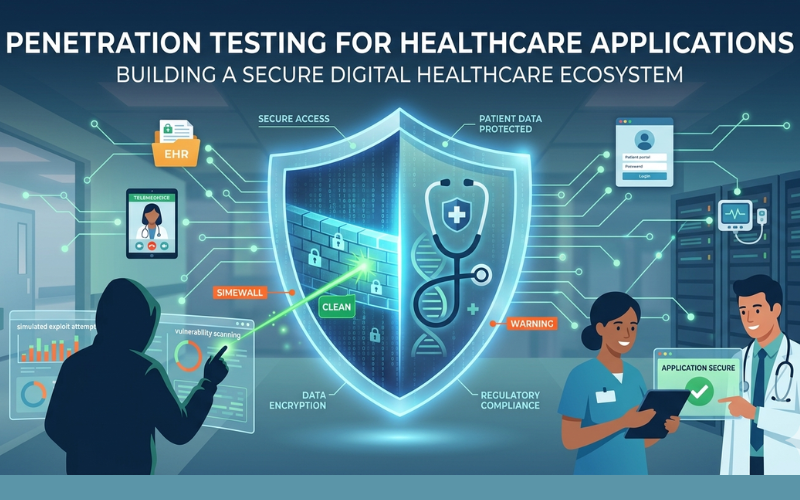
In today’s rapidly digitizing healthcare environment, protecting patient information has become a critical priority for healthcare organizations. Penetration testing (pen testing) is a security practice where experts simulate real-world cyberattacks on healthcare applications to identify vulnerabilities before malicious attackers can exploit them.
For healthcare organizations, penetration testing helps safeguard sensitive patient data, maintain system reliability, and meet regulatory requirements such as HIPAA, HITECH, and FDA cybersecurity guidelines.

Read More: Healthcare Compliance Testing Checklist for HIPAA, HL7, and FDA
Understanding Penetration Testing in Healthcare
Penetration testing is a proactive cybersecurity assessment designed to evaluate how secure an application or system truly is. Instead of simply detecting vulnerabilities, ethical security testers attempt to exploit them in a controlled environment to understand their real impact.
Healthcare systems often manage critical medical and personal information, making them attractive targets for cybercriminals.
Vulnerability Scanning vs Penetration Testing
Although often confused, vulnerability scanning and penetration testing serve different purposes.
🔯Vulnerability Scanning
- Automated process
- Detects known security weaknesses
- Generates a list of potential risks
🔯Penetration Testing
- Combines manual and automated testing
- Simulates real attack scenarios
- Confirms whether vulnerabilities can be exploited
Using both approaches helps healthcare organizations build stronger security defences.
Healthcare Applications That Require Testing
Several healthcare platforms handle sensitive patient information and therefore require thorough security testing, including:
- Electronic Health Record (EHR) systems
- Telemedicine platforms
- Patient portals and healthcare mobile apps
- Laboratory and diagnostic systems
- Hospital management software
Why Penetration Testing Is Critical for Healthcare Applications?
Healthcare organizations store vast amounts of Protected Health Information (PHI) and Personally Identifiable Information (PII). If compromised, this information can lead to severe financial, legal, and reputational damage.
Penetration testing helps healthcare organizations identify and fix security vulnerabilities before attackers can exploit them.
Key Benefits of Penetration Testing
- Protect sensitive patient data from unauthorized access
- Identify security vulnerabilities before attackers exploit them
- Prevent ransomware and cyberattacks targeting hospital systems
- Support compliance with healthcare regulations such as HIPAA and HITECH
- Strengthen patient trust by maintaining strong security practices
Types of Penetration Testing for Healthcare Applications
🔯Network Penetration Testing
This testing evaluates the security of hospital networks, servers, and firewalls to detect misconfigurations or vulnerabilities that attackers could use to gain unauthorized access.
🔯Application Penetration Testing
Application testing focuses on web and mobile healthcare applications such as EHR systems and patient portals. It helps identify issues related to authentication, session handling, and input validation.
🔯API Penetration Testing
Healthcare platforms exchange sensitive data through APIs using standards like HL7 and FHIR. API penetration testing ensures these interfaces are secure and properly protect patient information from unauthorized access.
🔯Social Engineering Testing
This testing evaluates how employees respond to security threats such as phishing emails or fraudulent requests, helping organizations improve security awareness and reduce human-related risks.
Tools Used for Healthcare Penetration Testing
Security professionals rely on specialized tools to perform penetration testing effectively.
Common tools include:
- OWASP ZAP – Detects security vulnerabilities in web applications
- Burp Suite – Intercepts and analyzes web traffic for security testing
- Metasploit – Simulates real-world attack scenarios
- Nmap and Nessus – Identify network vulnerabilities and exposed services
Best Practices for Healthcare Penetration Testing
To achieve effective security outcomes, healthcare organizations should follow several best practices.
🔯 Conduct Regular Testing
Security testing should be performed periodically rather than as a one-time activity. Continuous testing ensures that new vulnerabilities are detected early.
🔯Focus on High-Risk Systems
Systems storing large volumes of patient data—such as EHR platforms and patient portals—should receive priority during testing.
🔯Document and Remediate Findings
Every penetration test should generate a detailed report outlining vulnerabilities, risk levels, and recommended remediation steps.
🔯Encourage Collaboration
Security testing works best when developers, QA teams, and security professionals collaborate to fix vulnerabilities early in the development lifecycle.
Challenges in Healthcare Penetration Testing
Despite its importance, penetration testing in healthcare environments can be complex.
Common challenges include:
- Complex HL7 and FHIR integrations between healthcare systems
- Legacy infrastructure with outdated security controls
- Ensuring uninterrupted healthcare services during testing
- Large attack surfaces due to APIs, applications, and connected medical devices
Conclusion
Penetration testing is an essential cybersecurity practice for modern healthcare applications. By proactively identifying vulnerabilities, healthcare organizations can protect sensitive patient information, prevent cyberattacks, and maintain compliance with industry regulations.
As healthcare systems continue to digitize, regular and proactive penetration testing becomes critical for ensuring secure, reliable, and trustworthy healthcare services.

