
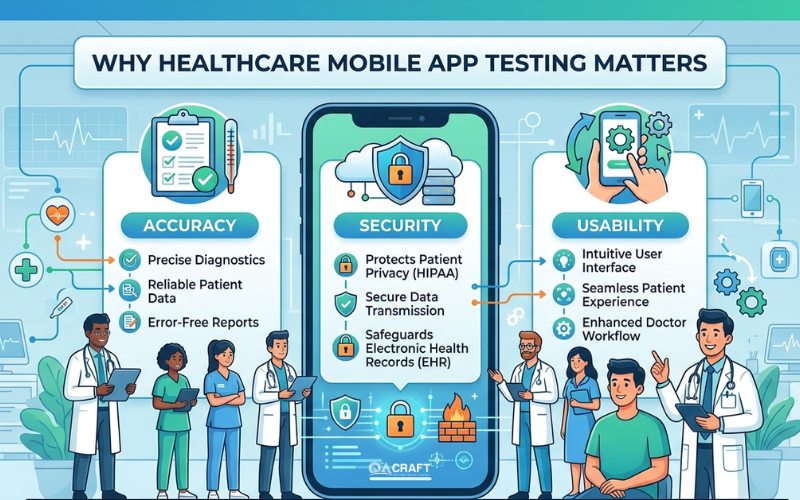
Healthcare mobile applications are fundamentally changing how patients and medical professionals interact with healthcare systems. These apps are now integral to modern healthcare, facilitating everything from appointment scheduling and medical information access to chronic illness management and telemedicine consultations. Given the sensitive nature of the medical data they handle and the critical healthcare decisions they support, these applications must function perfectly. This is why testing mobile apps for healthcare is so vital.

Read More: What are Healthcare Software Testing Services?
Accuracy is paramount in any healthcare application.
Medical apps frequently handle sensitive information, such as patient records, diagnostic reports, prescriptions, and vital health indicators.
Even a small error in this data can have serious consequences. Consider the potential for inappropriate medical care stemming from incorrect test results, improper medication dosages, or flawed health assessments.
Testing mobile apps in the healthcare sector serves several critical purposes. It ensures the precise documentation and safeguarding of patient information. It also confirms the accurate presentation of prescription medications and medical reports. Furthermore, it validates the correctness of calculations related to health metrics like blood pressure, glucose levels, and BMI. Finally, it verifies the proper synchronization between medical sensors and wearable devices.
Testers conduct rigorous validation to ensure the accurate processing and display of data across diverse devices and operating systems. This level of testing is essential for supporting sound healthcare decisions and minimizing the risk of medical errors.
Medical Mobile App QA: Ensuring Safe, Reliable, and User-Friendly Healthcare Applications
By enabling patients and healthcare providers to access services at any time and from any location, medical mobile applications are quickly revolutionizing the healthcare industry. These apps are essential to modern healthcare, from electronic medical records and appointment scheduling to telemedicine consultations and health monitoring. Medical mobile app QA (Quality Assurance) is crucial to ensuring these apps are accurate, secure, and dependable because they handle sensitive patient data and support clinical decisions.
Ensuring the accuracy of medical data is one of the main objectives of medical mobile app quality assurance. Important data, including prescriptions, diagnostic reports, health metrics, and patient histories, are frequently managed by healthcare apps. Any inaccuracy in this data may result in poor treatment choices or misunderstandings between medical professionals and patients. To ensure that data is appropriately collected, processed, and displayed across various devices and operating systems, QA teams test the application.
Medical Health Testing Services: Ensuring Safe and Reliable Healthcare Applications
Healthcare technology is changing quickly. Mobile apps, telemedicine platforms, wearable devices, and digital health systems are now essential tools for modern healthcare. These technologies handle private patient data and help doctors make important medical decisions. This is why medical health testing services are so important for making sure that healthcare apps are safe, accurate, and dependable.
The main job of medical health testing services is to make sure that healthcare software works properly and meets industry standards. These services help healthcare organizations find problems before apps are used by patients or medical professionals. Testing the system properly lowers the chance of it failing, giving out wrong medical information, or letting in hackers, all of which could put patients’ safety at risk.

