
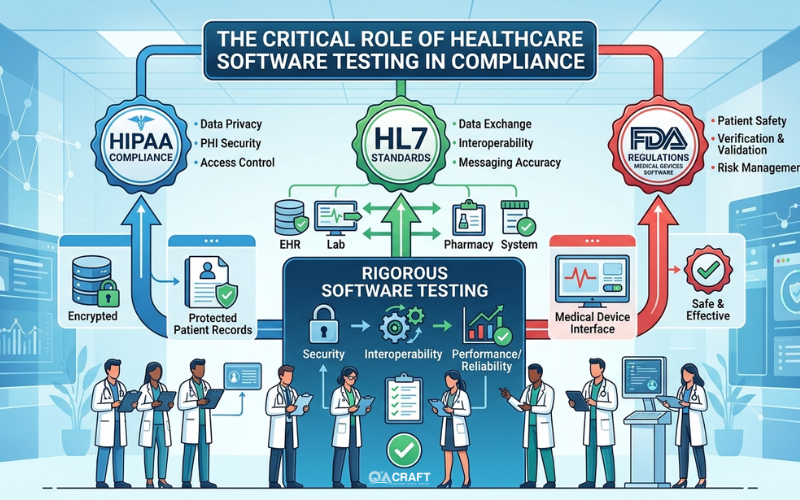
Software systems that are becoming more important to healthcare organizations include Electronic Health Records (EHR), telemedicine, medical equipment, and hospital administration systems. They are systems that store, process, and transmit sensitive patient data and are essential in patient care. Due to this fact, healthcare software has to meet very strict regulatory requirements,s including HIPAA, HL7, and FDA. The testing of healthcare software helps in the assurance of the compliance of these systems with regulatory requirements, safeguarding of patient data, ensuring the d safety and reliable functioning.
The Reason for Compliance in Healthcare Software.
Healthcare software contains extremely sensitive information, such as medical history, diagnoses, prescriptions, and personal identification of patients. Any violation, malfunction,n or mismanagement of data can have severe repercussions in the form of legal action, loss of patient privacy, or even patient safety.
There are regulatory frameworks such as HIPAA, HL7, and FDA regulations that are applied to achieve security, interoperability, accuracy,y and safety of healthcare systems. The most important process is testing to ensure that software systems adhere to these regulations in the right way.
Healthcare software can not be tested properly, and this may result in financial fines, revocation of trust, and prosecution of healthcare providers or software vendors.
Testing in HIPAA Compliance.
The Health Insurance Portability and Accountability Act (HIPAA) is aimed at securing the sensitive health information of patients (PHI). The patient data should be secret, safe, and accessible to the authorized persons only through the healthcare software.
Healthcare software testing is important in ensuring that HIPAA compliance is met by conducting a number of tests. Security testing will guarantee that unauthorized users do not access patient information. Authentication and authorization testing ensure that only certified medical staff can receive certain data regarding their positions.
Encryption testing makes sure that the data of the patients is safe in the course of transmission and storage. Moreover, penetration testing assists in determining the weak areas that can be used by hackers. Audit trail testing and logging help to ensure that the use of patient data and any alterations are sufficiently documented.
Provided that healthcare software is not in compliance with the HIPAA requirements, organizations may suffer huge fines and loss of their reputation.
HL7 Compliance Testing Importance.
HL7 (Health Level Seven) is a collection of global standards applied to exchange, integrate, and share healthcare information between various medical systems. Some of the frequently used systems used by hospitals include laboratory systems, radiology systems, pharmacy systems, and EHR platforms. HL7 makes certain that such systems will be able to communicate with one another.
Healthcare software testing also ensures data is rightly sent between systems using HL7 protocols. Integration testing also makes sure that messages are shared without failures, like patient admission messages, laboratory results, and discharge summaries.
Also tested is the compatibility of systems between their message formats, data fields,s and system responses. Loss of data, wrong patient information,n or delays in treatment can be the result of improper structuring or transmission of HL7 messages.
Through comprehensive interoperability and integration testing, healthcare organizations can be able to start and end critical data about patients with accuracy flowing through various systems.
FDA Compliance of Medical Software and Devices.
FDA also regulates software that is applied to medical devices and some medical-related applications that have a direct influence on patient diagnosis, monitoring, or treatment. Medical devices control software or aids in clinical decision making should be of the highest standards in the eyes of the FDA as a guarantee of safety and reliability.
Healthcare software testing can be used to ensure that these systems do what they are supposed to do without being harmful to patients. Functional testing is used to give the software appropriate behaviors in varying conditions. Performance testing ensures that the system is stable when it is being used heavily.
The software controlled by the FDA also requires risk-based testing. The testers discover the possible risks that may impact patient safety and confirm that suitable safeguards are provided. Moreover, validation and verification testing are the methods that ensure that the software requirements are established, as well as that it meets the requirements of the clinical requirements.
Another relevant feature of FDA compliance is proper documentation. Testing teams keep records of test cases, results, and validation processes in great detail to evidence the regulatory compliance in case of an audit.
Methods of Testing in Healthcare Software.
Read More: Healthcare Compliance Testing Checklist
Testing of healthcare software has numerous testing methods to meet the regulations. Functional testing is used to test that the software functionality is functioning as desired. Security testing prevents cyber threats to sensitive patient information. Integration testing can guarantee communication within various healthcare systems.
Performance testing is used to determine whether systems can accept high quantities of patient information and users. The usability testing will make sure that the healthcare professionals do not find it difficult to use the system without errors. Standard testing, in particular, authenticates compliance with HIPAA, HL7,7 and FDA standards.
A combination of these testing procedures guarantees the reliability of healthcare software and its securi, ty as well as its compliance with regulatory measures.
Conclusion
Medical software is important in patient care, medical decision-making, and hospital processes. Since healthcare information is highly sensitive and there is a high chance of potential attacks by software failure, it is important to comply with the regulatory requirements.
Healthcare software testing is done to ensure that the systems comply with HIPAA requirements of patient data security, HL7 requirements of interoperability, and FDA requirements of medical software safety. Organizations are able to avoid the risk of security breaches, ensure correct data exchange, and maintain patient safety through thorough testing strategies.
Finally, proper healthcare software testing not only guarantees compliance with regulations but also creates trust between healthcare providers and patients, which allows safer and more reliable healthcare technology to be put in place.

