
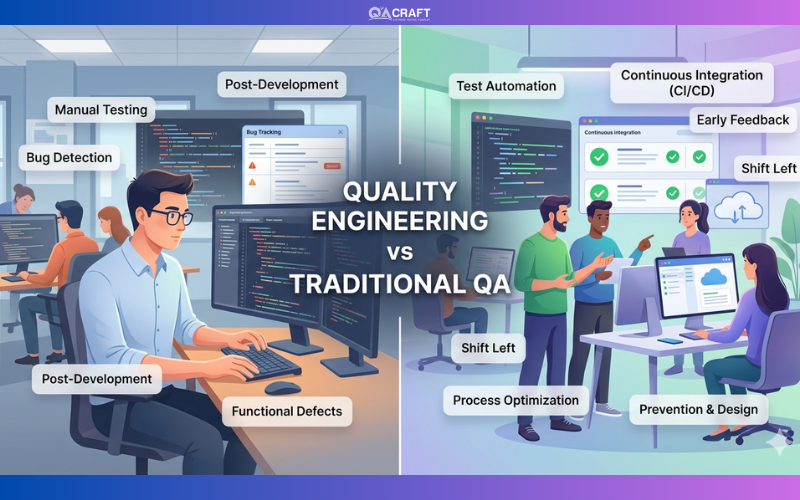
Software quality is no longer just about detecting bugs before release. Modern development teams focus on continuous quality, automation, and early defect prevention. This shift has introduced Quality Engineering (QE) as an advanced approach compared to traditional QA.
Understanding Quality Engineering vs QA helps organizations deliver faster releases while maintaining reliability and performance.
What Is Quality Engineering vs Traditional QA?
Quality Engineering vs Traditional QA refers to the difference between a modern, proactive approach to software quality and the older reactive testing model.
- Traditional QA focuses mainly on defect detection after development.
- Quality Engineering (QE) integrates quality across the entire software development lifecycle.
- QE emphasizes automation, continuous testing, and early defect prevention.
- Traditional QA often relies heavily on manual testing and late-stage validation.
Understanding Traditional QA in Software Testing
Traditional QA (Quality Assurance) is the conventional testing model where testers verify the functionality of an application after development is completed.
Typical characteristics of traditional QA include:
- Manual testing processes
- Testing performed after development phases
- Focus on finding bugs rather than preventing them
- Limited automation adoption
What Is Quality Engineering in Software?
Quality Engineering in software is a modern testing strategy that integrates quality practices across the entire development lifecycle.
Instead of simply testing the final product, QE focuses on:
- Building quality into the development process
- Automating testing workflows
- Using analytics and AI-driven testing tools
- Supporting DevOps and continuous delivery pipelines
Quality Engineering ensures that software quality is maintained from design to deployment.
For deeper insights into testing frameworks used in modern QA environments

Read More: What is Test Automation Framework?
Key Differences: Quality Engineering vs QA
Below is a comparison of QA vs QE to better understand how the two approaches differ.
| Aspect | Traditional QA | Quality Engineering |
|---|---|---|
| Approach | Reactive | Proactive |
| Focus | Detect defects | Prevent defects |
| Efficiency | Time-consuming | Improved productivity |
| Testing Phase | Late-stage testing | Continuous testing |
Conclusion
Understanding Quality Engineering vs Traditional QA is essential for organizations aiming to improve software quality in modern development environments.
While traditional QA focuses on detecting bugs after development, Quality Engineering emphasizes proactive testing, automation, and continuous quality validation.

