
One of the biggest reasons is the traditional approach, where testing happens only at the end of development. By the time issues are discovered, fixing them becomes time-consuming, expensive, and sometimes risky.
This approach often leads to:
- Last-minute bug discoveries
- Increased development and maintenance costs
- Delays in product releases
In today’s Agile and DevOps environments, where teams aim for faster delivery, understanding agile testing principles becomes essential. Teams need a smarter way to ensure quality without slowing down progress.
This is where shift-left testing becomes important. To understand how this differs from older approaches, you can explore quality engineering vs. traditional QA. It focuses on starting testing activities early in the development process so that issues can be identified and resolved before they turn into bigger problems.
What is Shift-Left Testing?
Definition
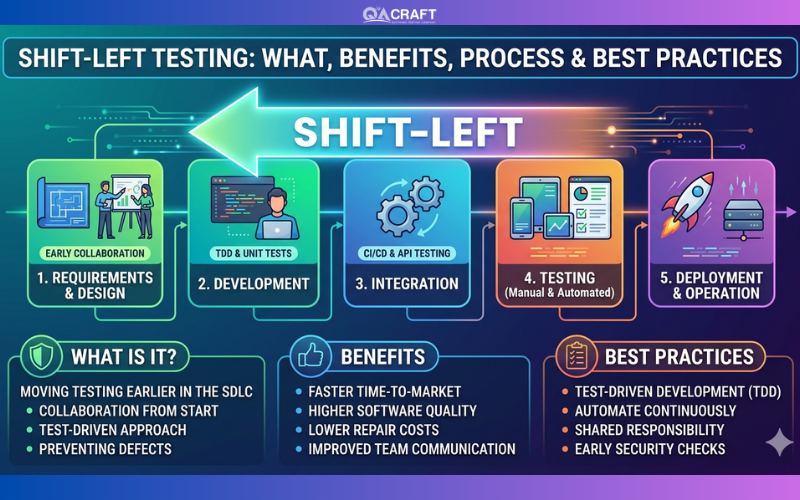
Shift-left testing is a software testing approach where testing activities are moved earlier in the software development lifecycle instead of being performed only at the final stages.
Understanding the Concept
The idea behind this approach is simple:
Detect defects as early as possible to reduce risk and cost.
Instead of waiting for a complete build, teams start validating:
- Requirements
- Design decisions
- Code functionality
Why is it Called “Shift-Left”?
If you visualize the development lifecycle as a timeline:
- Traditional testing happens on the right side (end)
- Shift-left testing moves activities to the left side (earlier stages)
This shift allows teams to catch issues sooner and avoid last-minute surprises.
Collaboration in Shift-Left Testing
Shift-left testing promotes collaboration across teams:
- Developers write testable and reliable code
- QA identifies risks early
- Product teams ensure clarity in requirements
Quality becomes a shared responsibility rather than a separate phase.
Why QA Should Start at the Design Stage
Starting QA early, especially during the design phase, brings significant advantages.
🗣️ Early Defect Detection
Issues are identified before coding begins, preventing major defects later in the lifecycle.
🗣️ Improved Software Quality
Design flaws are caught early, resulting in better architecture and system stability.
🗣️ Reduced Development Costs
Fixing a defect during design is far cheaper than fixing it after development or in production.
🗣️ Better Collaboration
Developers, testers, and designers work together, leading to a clearer understanding and fewer misunderstandings.
How Shift-Left Testing Works
Shift-left testing is not a single step—it is a continuous process integrated into every stage of development.
🗣️ Requirement Analysis
QA reviews requirements to ensure they are clear, complete, and testable. Missing scenarios are identified early.
🗣️ Design Validation
Testers analyse architecture and design documents to identify risks and potential issues before development starts.
🗣️ Unit Testing
Developers write automated tests while coding to ensure individual components function correctly. Developers write automated tests while coding. Learn more about unit testing best practices to strengthen code quality.
🗣️ Continuous Integration Testing
Automated tests run in CI/CD pipelines to validate every code change and detect issues instantly.
Real-World Example: How Shift-Left Testing Helps
Consider a simple login feature in an application.
Without Shift-Left Testing
- The feature is developed first
- QA tests it later
Issues found:
- Missing validation rules
- Weak password handling
Result: Rework, delays, and increased cost
With Shift-Left Testing
- QA reviews requirements early
- Identifies missing validations before development
- Developers implement correct logic from the start
Result:
- Fewer bugs
- Faster delivery
- Better user experience
Benefits of Shift-Left Testing
Adopting this approach provides clear advantages.
🗣️ Faster Bug Detection
Issues are caught early before they reach production.
🗣️ Lower Development Costs
Early fixes require less effort and reduce overall cost.
🗣️ Faster Release Cycles
Continuous testing and automation speed up delivery.
🗣️ Higher Software Quality
Applications become more stable, reliable, and user-friendly.
Tools That Support Shift-Left Testing
To implement shift-left testing effectively, teams rely on modern tools.
🗣️ Selenium
Used for automating web application testing and ensuring functionality early in development. Selenium is widely used for automating web applications. If you’re getting started, check out our detailed Selenium automation guide.
🗣️ JUnit
Helps developers write and run unit tests for Java applications.
🗣️ TestNG
Provides advanced testing features like parallel execution and reporting.
🗣️ Jenkins
Automates testing within CI/CD pipelines for continuous validation.
🗣️ Cypress
Enables fast and reliable end-to-end testing for modern web applications.
These tools support automation and continuous testing, making early testing practical and scalable.
Challenges of Implementing Shift-Left Testing
Despite its benefits, adopting shift-left testing comes with challenges.
✍ Cultural Shift
Teams must move away from traditional workflows and adopt a quality-first mindset.
✍ Skill Gaps
Developers may need to learn testing tools and practices.
✍ Initial Setup Effort
Setting up automation frameworks and CI/CD pipelines requires time and planning.
✍ Collaboration Challenges
Effective communication between teams is essential but can be difficult to maintain.
Best Practices for Successful Shift-Left Testing
To successfully implement this approach, teams should follow these best practices.
✍ Involve QA Early
Include testers in requirement discussions and design reviews.
✍ Focus on Automation
Automate unit and integration testing to improve efficiency
✍ Use CI/CD Pipelines
Enable continuous testing with every code change.
✍ Encourage Collaboration
Ensure developers and testers work closely throughout the development lifecycle.
Shift-Left Testing vs Traditional Testing
| Aspect | Traditional Testing | Shift-Left Testing |
|---|---|---|
| Testing Phase | Happens at the end | Starts early in development |
| Bug Detection | Bugs are found late | Bugs are detected early |
| Cost of Fixing Defects | High cost | Lower cost |
| Release Cycle | Slower releases | Faster releases |
️Future of Shift-Left Testing in Agile and DevOps
Shift-left testing continues to evolve with modern technologies.
✍ AI-Driven Testing
AI helps predict defects, improve test coverage, and reduce manual effort.
✍ Intelligent Automation
Automation tools are becoming smarter, enabling faster and more accurate testing.
✍ Continuous Testing
Testing is fully integrated into DevOps pipelines, ensuring quality at every stage of development.
Conclusion
Shift-left testing is more than just a testing approach—it is a mindset that focuses on building quality from the beginning.
By starting to test early in the development lifecycle, teams can:
- Detect defects sooner
- Reduce development costs
- Improve collaboration
- Deliver high-quality software faster
The key takeaway is simple:
The earlier you test, the better your software becomes.

