
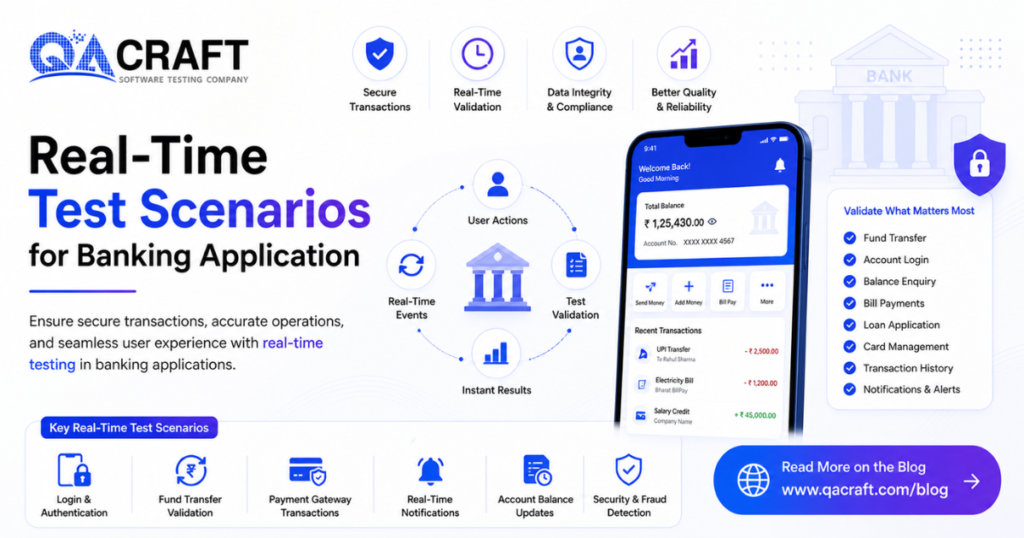
In today’s fast-paced digital world, banking applications must be secure, reliable, and highly responsive. Even a minor defect can lead to financial loss, compliance issues, or a breakdown in customer trust. That’s why validating real-time test scenarios for banking applications is critical for delivering high-quality software.
In this guide, we’ll walk through practical, real-world banking test scenarios every QA engineer should cover, along with key testing strategies.
Why Real-Time Testing is Important in Banking Applications
Banking systems deal with sensitive financial data, high-volume transactions, and strict regulatory requirements. Real-time testing ensures:
- Seamless user experience
- Secure transactions
- Accurate data processing
- Compliance with financial regulations
To build a strong foundation, it’s important to understand core testing practices like API testing and end-to-end testing, which play a crucial role in validating banking workflows.
Key Modules in Banking Applications
Before diving into test scenarios, it’s important to understand the core modules:
- User Authentication & Login
- Account Management
- Fund Transfer
- Transaction History
- Loan & Credit Services
- Notifications & Alerts
Each of these modules requires a combination of functional testing and non-functional testing to ensure complete validation.
Real-Time Test Scenarios for Banking Applications
1. Login & Authentication Scenarios
- Verify login with valid credentials
- Validate the error message for invalid login
- Check the account lock after multiple failed attempts
- Test OTP-based authentication
- Verify session timeout functionality
Security is critical here, so incorporating security testing and validating APIs through API security testing ensures robust protection.
2. Fund Transfer Scenarios
- Transfer money between the same bank accounts
- Transfer money to different banks (NEFT/RTGS/IMPS)
- Validate the insufficient balance scenario
- Verify transaction failure and rollback
- Check duplicate transaction prevention
These scenarios should also be validated during regression testing cycles to ensure stability after updates.
💡 Pro Tip: Always test transaction consistency under high load conditions.
3. Account Management Scenarios
- Verify account details display correctly
- Update user profile and validate changes
- Check the account balance accuracy after transactions
- Validate account statement generation
To ensure accuracy, apply strong data validation testing techniques and well-structured test cases.
4. Transaction History Scenarios
- Verify transaction records are accurate
- Check date-wise and filter functionality
- Validate download (PDF/Excel) options
- Ensure real-time updates after transactions
Proper handling of test data is essential, making test data management a key focus area.
5. Payment & Bill Processing Scenarios
- Pay utility bills successfully
- Validate payment failure handling
- Check duplicate payment prevention
- Verify payment confirmation notifications
These flows are best validated using end-to-end testing to simulate real user journeys.
6. Security Testing Scenarios
- Test SQL injection vulnerabilities
- Validate CSRF protection
- Check the encryption of sensitive data
- Verify secure session handling
For deeper validation, include penetration testing and advanced cloud penetration testing practices.
🚀 Automation in Banking Testing
As banking systems grow more complex, manual testing alone isn’t enough. Integrating automation testing helps improve efficiency, speed, and coverage.
Modern QA teams are also adopting test automation frameworks and advanced approaches like self-healing test automation to reduce maintenance effort and improve test reliability.
Final Thoughts
Banking applications demand the highest level of precision, security, and performance. By covering real-time test scenarios across all critical modules—authentication, transactions, payments, and security—QA teams can significantly reduce risks and ensure a seamless user experience.
Combining strong testing fundamentals with automation and modern QA practices is the key to building reliable and future-ready banking systems.

