
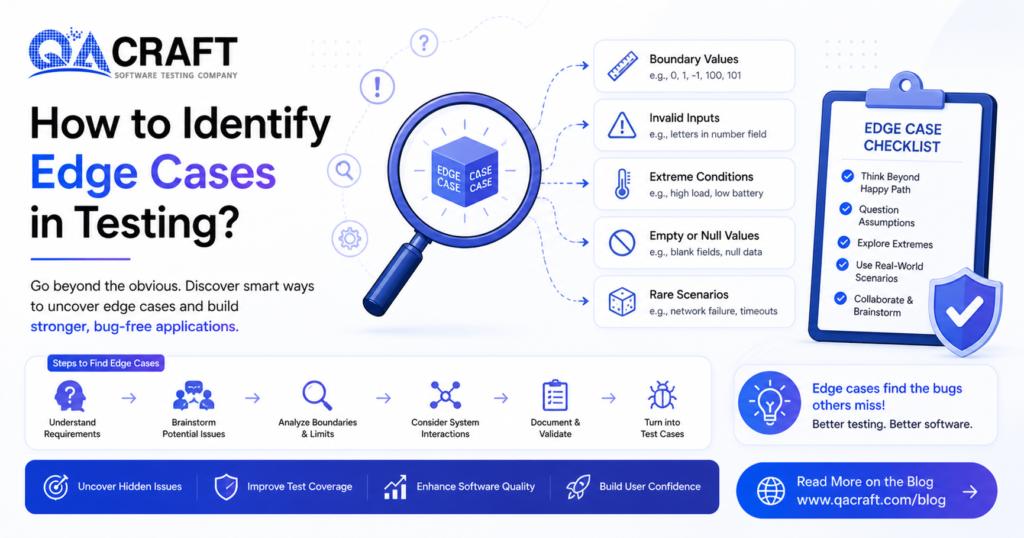
When we test software, we usually check normal scenarios — users logging in, filling forms, or making payments, and everything works as expected.
But real users don’t always behave normally. They enter invalid data, click repeatedly, or use the system under unexpected conditions.
This is where edge cases become critical.
Edge cases are scenarios that occur at extreme limits or unusual conditions. They are not common, but they often reveal the most serious and hidden bugs in a system.
What Are Edge Cases?
Edge cases are test scenarios that occur at the boundary or extreme conditions of a system. They typically arise when:
- Input reaches the minimum or maximum limit
- User does unexpected actions
- The system is under stress
- Rare conditions occur
For Examples:
- Clicking the button many times
- Losing internet during payment
- Entering 256 characters in a 255-character field
To understand how such scenarios fit into broader QA practices, you can explore core concepts like functional testing and general software testing techniques.
Why Edge Cases Are Important?
Normal testing ensures the system works under expected conditions. Edge case testing ensures it behaves correctly under unexpected conditions.
Benefits of edge case testing:
- Finds hidden bugs
- Prevents production issues
- Improves system stability
- Improves user experience
- Reduces failure risk
Many critical production issues are discovered only through edge cases.
These issues are often linked with real-world defects, which is why understanding the bug life cycle is essential in QA.
You can also explore why testing matters in depth here: 👉 https://qacraft.com/why-software-testing-is-important-and-necessary/
How to Identify Edge Cases?
Identifying edge cases requires a strong testing mindset and structured techniques.
1. Boundary Value Analysis
Test values at minimum, maximum, and just outside limits.
2. Invalid Input Testing
Check how the system handles incorrect or unexpected input.
3. Unexpected User Behavior
Simulate real-world unpredictable actions.
4. System Limit Testing
Test system behavior under resource or data limits.
5. Combination Testing
Test multiple inputs and scenarios together.
6. Date and Time Testing
Check leap years, time zones, and invalid dates.
7. Concurrency Testing
Simulate multiple users performing actions simultaneously.
8. Error Handling Testing
Ensure proper handling of system failures.
9. Performance and Load Testing
Check system behavior under high load conditions.
10. “What If” Scenario Thinking
Ask: What could go wrong?
To design better test scenarios, you can refer to:
👉 https://qacraft.com/how-to-write-test-cases-in-software-testing/For advanced testing approaches, explore:
👉 https://qacraft.com/test-scenario-definition-importance-and-example/
Mindset for Finding Edge Cases
To effectively identify edge cases, testers must think beyond expected behavior.
Instead of only asking:
✔ “What should work?”
You must also ask:
✔ “What can go wrong?”
✔ “How can the system break?”
✔ “What if users behave unexpectedly?”
This mindset aligns closely with modern testing approaches like shift left testing and Agile QA practices:
Automation also plays a key role in validating edge cases efficiently:
Edge Cases in Automation Testing
Edge cases are increasingly being handled using automation frameworks to ensure consistency and speed.
Modern QA teams use:
These approaches help reduce maintenance effort and improve test reliability.
Conclusion
Edge cases may be rare, but they are extremely powerful in uncovering hidden system issues.
To identify them effectively:
- Test boundary conditions
- Try invalid inputs
- Simulate real user behavior
- Push system limits
- Combine multiple scenarios
- Think in “what if” situations
Testing is not just about validating normal flows — it is about breaking things before users do.
Because in real-world software, most critical bugs live on the edges, not in the center.

