
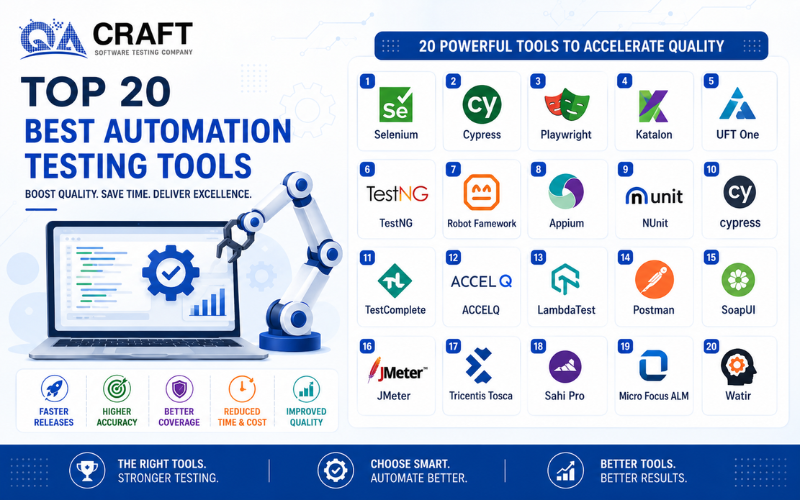
Automation testing has become an essential part of modern software development. As businesses move toward faster release cycles and continuous delivery, QA teams need reliable automation testing tools to improve testing speed, accuracy, and software quality.
Choosing the right automation testing tool can help organizations:
🪟 Reduce manual testing effort
🪟 Improve test coverage
🪟 Accelerate software delivery
🪟 Support CI/CD pipelines
🪟 Improve regression testing efficiency
Today, many automation tools are available for:
🪟 Web testing
🪟 Mobile app testing
🪟 API testing
🪟 Performance testing
🪟 Cross-browser testing
In this blog, we will explore the Top 20 Best Automation Testing Tools along with their features, benefits, and use cases.
If you are new to automation, you can first understand what is automation testing and how automation testing works.
Why Automation Testing Tools are Important?
Automation testing tools help testers automate repetitive tasks and improve testing efficiency. These tools are widely used in Agile and DevOps environments where faster releases and continuous testing are required.
Benefits of automation testing tools include:
🪟 Faster test execution
🪟 Better accuracy
🪟 Reduced human errors
🪟 Reusable test scripts
🪟 Improved regression testing
🪟 Better CI/CD integration
You can also learn about the automation testing lifecycle and test automation frameworks.
Top 20 Best Automation Testing Tools
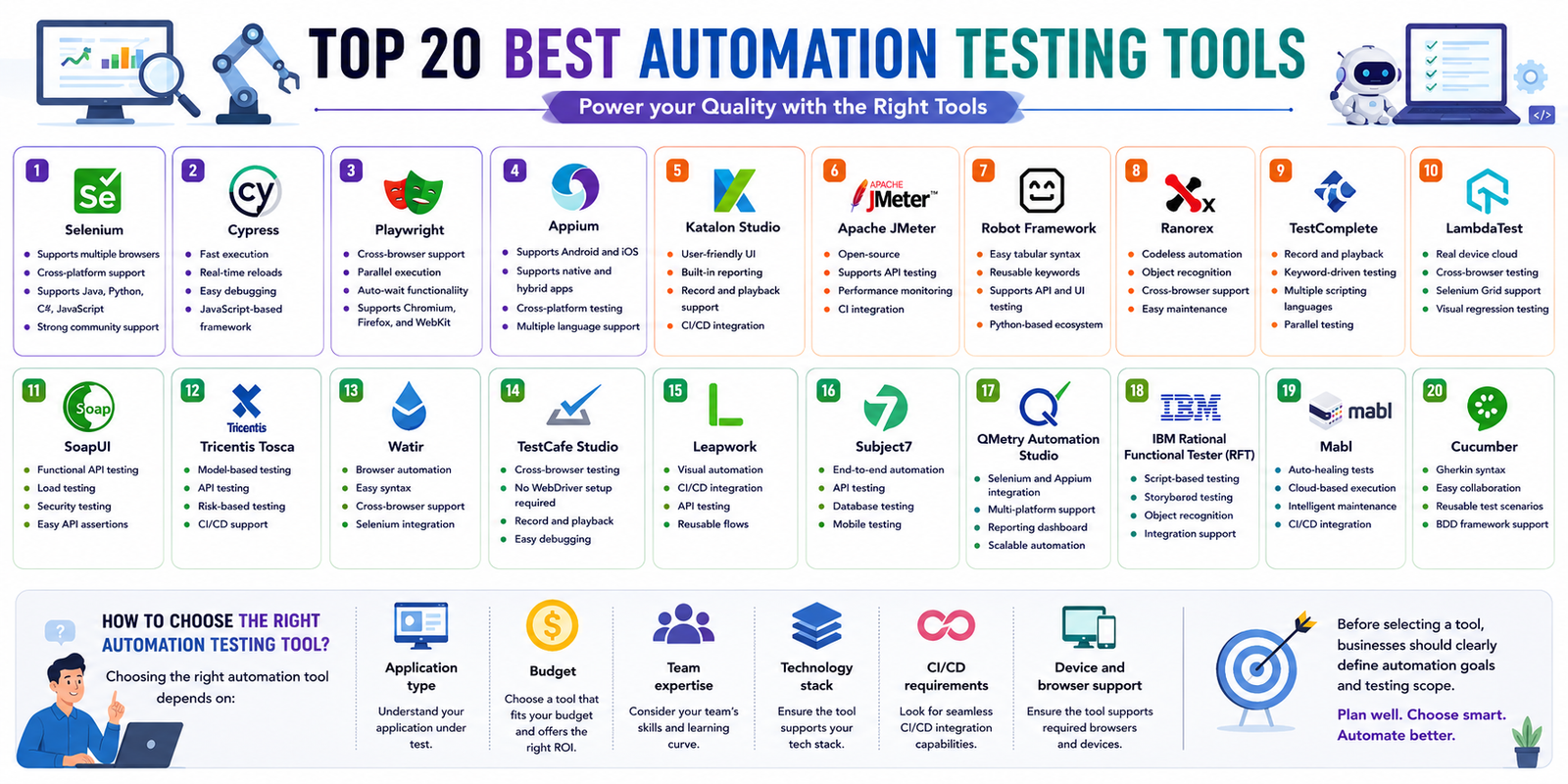
🪆 Selenium
Selenium is one of the most popular open-source automation testing tools for web applications.
Key Features
🍃 Supports multiple browsers
🍃 Cross-platform support
🍃 Supports Java, Python, C#, JavaScript
🍃 Strong community support
Selenium is widely used for:
🍂 Web automation
🍂 Regression testing
🍂 Cross-browser testing
You can also explore:
🏎 Benefits of Selenium WebDriver
🏎 Selenium Best Practices
🪆 Cypress
Cypress is a modern frontend testing framework mainly used for end-to-end web testing.
Key Features:
🍃 Fast execution
🍃 Real-time reloads
🍃 Easy debugging
🍃 JavaScript-based framework
Cypress is highly popular among frontend developers and QA teams.
🪆 Playwright
Playwright is a modern automation framework developed by Microsoft for end-to-end testing.
Key Features:
🍃 Cross-browser support
🍃 Parallel execution
🍃 Auto-wait functionality
🍃 Supports Chromium, Firefox, and WebKit
You can also explore how Playwright Test Agents improve automation testing.
🪆 Appium
Appium is an open-source automation tool used for mobile application testing.
Key Features:
🍃 Supports Android and iOS
🍃 Supports native and hybrid apps
🍃 Cross-platform testing
🍃 Multiple language support
Appium is widely used for mobile testing strategies.
🪆Katalon Studio
Katalon Studio is an easy-to-use automation platform for:
🍂 Web testing
🍂 Mobile testing
🍂 API testing
🍂 Desktop testing
Key Features:
🍃 User-friendly UI
🍃 Built-in reporting
🍃 Record and playback support
🍃 CI/CD integration
🪆 Apache JMeter
Apache JMeter is widely used for:
🍂 Load testing
🍂 Performance testing
🍂 Stress testing
Key Features:
🍃 Open-source
🍃 Supports API testing
🍃 Performance monitoring
🍃 CI integration
You can also explore software performance testing.
🪆 Robot Framework
Robot Framework is an open-source automation framework that supports keyword-driven testing.
Key Features:
🍃 Easy tabular syntax
🍃 Reusable keywords
🍃 Supports API and UI testing
🍃 Python-based ecosystem
🪆 Ranorex
Ranorex is a commercial automation testing tool for:
🍂 Desktop applications
🍂 Web applications
🍂 Mobile applications
Key Features:
🍃 Codeless automation
🍃 Object recognition
🍃 Cross-browser support
🍃 Easy maintenance
🪆 TestComplete
TestComplete by SmartBear supports:
🍂 Web testing
🍂 Desktop testing
🍂 Mobile testing
Key Features:
🍃 Record and playback
🍃 Keyword-driven testing
🍃 Multiple scripting languages
🍃 Parallel testing
🪆 LambdaTest
LambdaTest is a cloud-based cross-browser testing platform.
Key Features:
🍃 Real device cloud
🍃 Cross-browser testing
🍃 Selenium Grid support
🍃 Visual regression testing
Learn more about cross-browser testing.
🪆 SoapUI
SoapUI is a popular API testing tool used for SOAP and REST API testing.
Key Features:
🍃 Functional API testing
🍃 Load testing
🍃 Security testing
🍃 Easy API assertions
You can also learn about top API testing tools.
🪆 Tricentis Tosca
Tricentis Tosca is an enterprise automation testing tool.
Key Features:
🍃 Model-based testing
🍃 API testing
🍃 Risk-based testing
🍃 CI/CD support
🪆 Watir
Watir is an open-source Ruby-based automation tool for web applications.
Key Features:
🍃 Browser automation
🍃 Easy syntax
🍃 Cross-browser support
🍃 Selenium integration
🪆 TestCafe Studio
TestCafe Studio is a codeless automation tool for web testing.
Key Features:
🍃 Cross-browser testing
🍃 No WebDriver setup required
🍃 Record and playback
🍃 Easy debugging
🪆 Leapwork
Leapwork is a no-code automation platform for enterprise testing.
Key Features:
🍃 Visual automation
🍃 CI/CD integration
🍃 API testing
🍃 Reusable flows
🪆 Subject7
Subject7 is a cloud-based automation testing platform.
Key Features:
🍃 End-to-end automation
🍃 API testing
🍃 Database testing
🍃 Mobile testing
🪆 QMetry Automation Studio
QMetry provides test automation, management, and analytics solutions.
Key Features:
🍃 Selenium and Appium integration
🍃 Multi-platform support
🍃 Reporting dashboard
🍃 Scalable automation
🪆 IBM Rational Functional Tester (RFT)
IBM RFT supports automated functional and regression testing.
Key Features:
🍃 Script-based testing
🍃 Storyboard testing
🍃 Object recognition
🍃 Integration support
🪆 Mabl
Mabl is an AI-powered automation testing platform.
Key Features:
🍃 Auto-healing tests
🍃 Cloud-based execution
🍃 Intelligent maintenance
🍃 CI/CD integration
Learn how self-healing automation improves automation efficiency.
🪆 Cucumber
Cucumber is a popular tool used for Behavior Driven Development (BDD).
Key Features:
🍃 Gherkin syntax
🍃 Easy collaboration
🍃 Reusable test scenarios
🍃 BDD framework support
You can also explore BDD frameworks.
How to Choose the Right Automation Testing Tool?
Choosing the right automation tool depends on:
🌸 Application type
🌸 Budget
🌸 Team expertise
🌸 Technology stack
🌸 CI/CD requirements
🌸 Device and browser support
Before selecting a tool, businesses should clearly define automation goals and testing scope.
You can also understand the scope of automation testing for better planning.
Challenges in Automation Testing
Although automation tools improve efficiency, some common challenges include:
🌸 High setup cost
🌸 Script maintenance
🌸 Dynamic UI handling
🌸 Tool learning curve
🌸 Frequent requirement changes
Following proper automation strategies helps reduce these challenges effectively.
Future of Automation Testing Tools
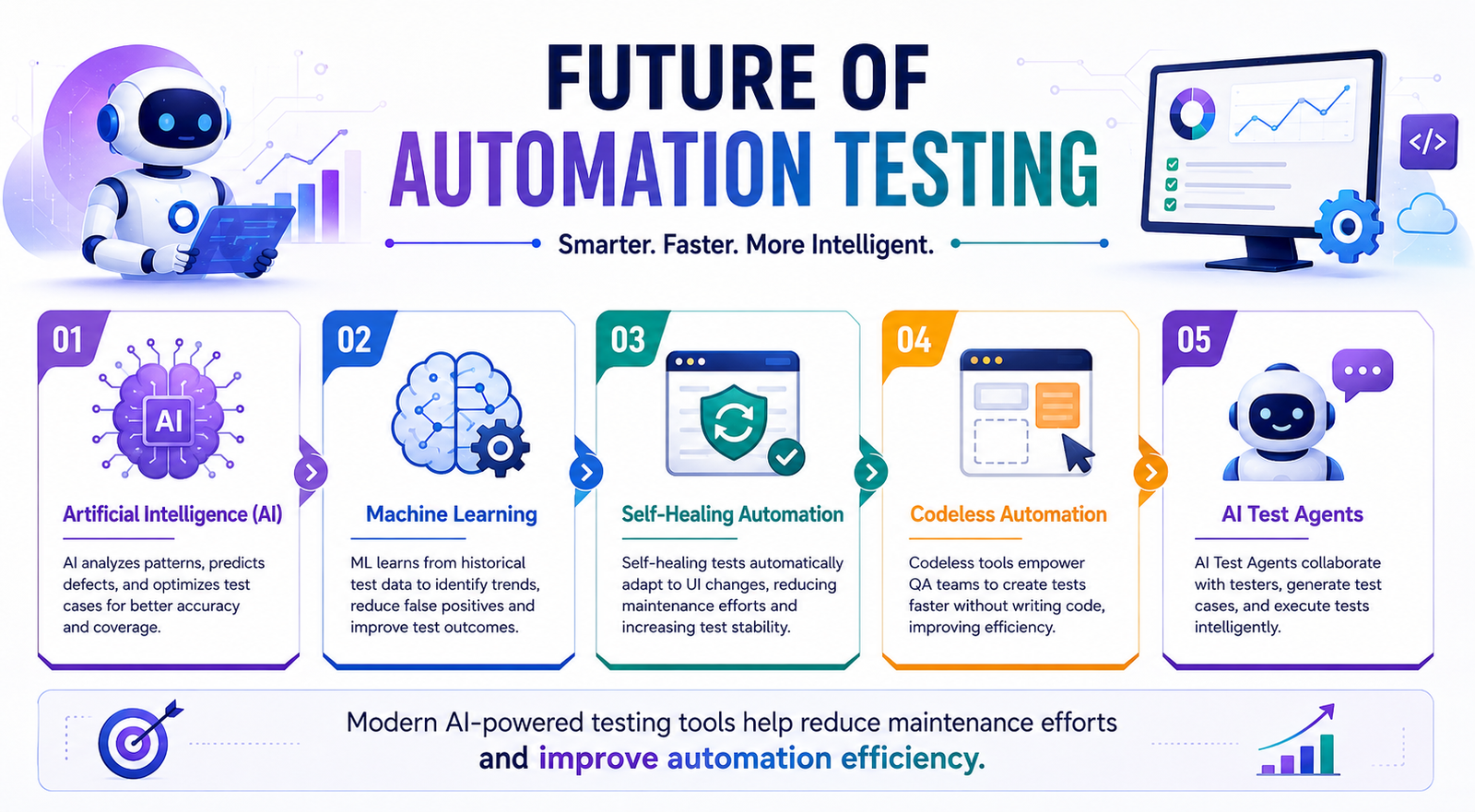
Modern automation tools are evolving rapidly with technologies like:
🌸 Artificial Intelligence (AI)
🌸 Machine Learning
🌸 Self-Healing Automation
🌸 Codeless Automation
You can also explore:
🏎 How LLMs are Changing Test Automation
🏎 AI and Machine Learning in Software Testing
Conclusion
Automation testing tools play a major role in improving software quality, accelerating releases, and reducing manual testing efforts.
Choosing the right automation testing tool depends on project requirements, team expertise, and business goals. Tools like Selenium, Cypress, Playwright, Appium, and JMeter are widely used because of their flexibility and strong community support.
Organizations that combine the right tools with proper automation strategies can improve testing efficiency and deliver better software products faster.
To continue learning automation testing, you can also explore:
🏎 Ultimate Guide to Automation Testing
🏎 Test Automation Frameworks
🏎 How Automation Testing Works
🏎 What are Codeless Automation Tools?

